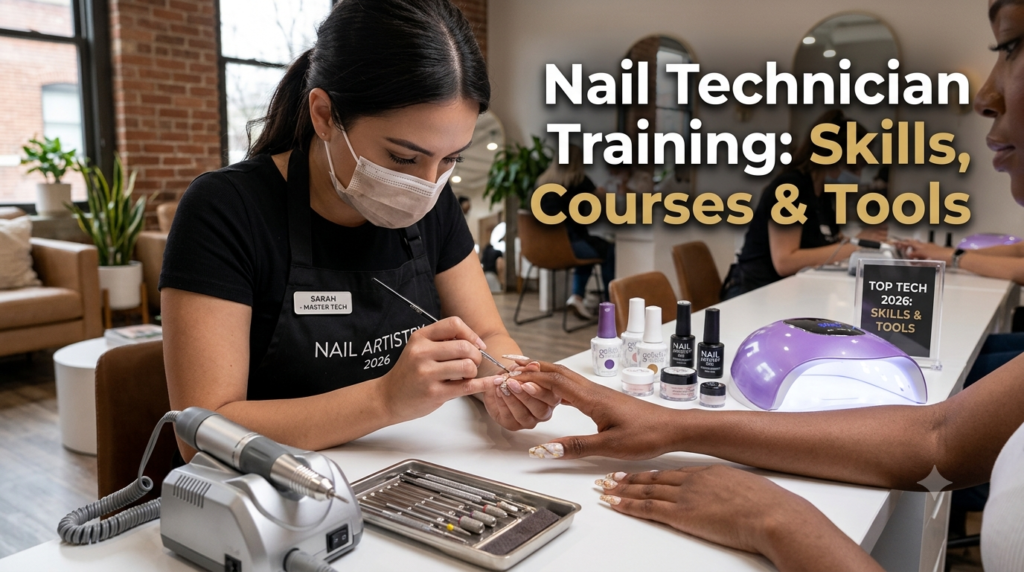
“Nail Technician Training: Skills, Courses & Tools
Becoming a skilled nail technician takes more than learning how to apply polish. From basic manicure techniques and nail care to advanced services, the right training can help you build confidence, improve your technique, and create better results for your clients.
In this guide, you’ll learn the essential nail technician skills, training options, tools, safety practices, and a practical learning path to help you grow professionally.
Becoming a good nail technician is about much more than creating beautiful nails.
Clients notice the final result, but professional nail work depends on everything that happens before the polish is applied: how you prepare the natural nail, how carefully you use your tools, how well you understand different nail types, and whether you know when a service should—or should not—be performed. Whether you are just starting your career or already have regular clients, there is always another skill to develop.
You may want to improve your manicure technique, learn how to use an e-file, become better at nail shaping, add pedicures to your services, or finally learn the nail-art techniques that take too long when you try to figure them out yourself. The good news is that you don’t have to learn everything at once.
A structured learning path can help you decide what to learn first, which tools are actually worth buying, and when advanced training makes sense.
Table of Contents
- What Does a Professional Nail Technician Need to Know?
- Start With Nail Anatomy and Safety
- Master the Basic Manicure
- Should You Learn E-File Manicure?
- What Is Russian Manicure?
- Learn Nail Shapes and Structure
- Don’t Ignore Problem Nails
- Add Pedicure Skills
- Nail Art Can Become a Valuable Skill
- Essential Nail Technician Tools
- Training vs. Learning From Free Videos
- How to Choose a Nail Technician Course
- Online vs. In-Person Training
- Where Does VEL Academy Fit?
- A Practical Learning Path for Beginners
- Common Mistakes New Nail Technicians Make
- Final Thoughts
- Frequently Asked Questions
What Does a Professional Nail Technician Need to Know?
There isn’t one single skill that makes someone a great nail technician.
Professional work combines several areas:
- Natural nail preparation
- Manicure techniques
- Nail shaping
- Product application
- E-file control
- Nail art
- Pedicure
- Problem-nail assessment
- Hygiene and sanitation
- Client communication
- Product knowledge
- Time management
You don’t necessarily need to master all of these on your first day.
Instead, think of your development as a series of layers.
First, build safe fundamentals. Then improve precision. After that, add advanced techniques and specialized services.
That approach is usually much more useful than buying every nail product you see online and hoping practice alone will fill the gaps.
Start With Nail Anatomy and Safety
Before learning an advanced manicure technique, understand what you are actually working on.
The nail unit contains several structures, and the skin surrounding the nail has an important protective role. The cuticle, for example, contributes to the barrier that helps prevent pathogens from entering the area around the nail. Research has linked aggressive cuticle manipulation with problems such as paronychia and nail damage.
This is why professional training should cover more than appearance.
A technician should understand:
- Basic nail anatomy
- Healthy vs. abnormal-looking nails
- When a service should be avoided
- Proper sanitation
- Tool handling
- Product safety
- Safe filing practices
- Client comfort
Salon safety also includes occupational exposure. OSHA guidance for nail salons covers chemical hazards, workplace safety, and ways to reduce risks for salon workers.
Beautiful nails should never come at the expense of nail or skin health.
Master the Basic Manicure First
Before moving into specialized techniques, make sure your fundamentals are strong.
You should be comfortable with:
- Nail preparation
- Basic shaping
- Gentle cuticle-area care
- Polish application
- Gel application, if relevant to your services
- Removal techniques
- Clean finishing
This sounds simple, but consistency is what separates an occasional DIY manicure from professional work.
A client should be able to receive the same quality result from you repeatedly—not just on the day when everything goes perfectly.
Should You Learn E-File Manicure?
If you want to work professionally, learning about e-file manicure can be a useful advanced skill.
An e-file can provide precision and efficiency, but it also requires control.
The important question isn’t simply:
“Which e-file should I buy?”
It is:
“Do I know how to use an e-file correctly?”
Before buying expensive equipment, learn about:
- Bit selection
- Speed control
- Pressure
- Movement
- Hand positioning
- Natural nail safety
- Dust control
- Cleaning and disinfection
- When not to use the tool
Using an electric file without proper training can create unnecessary risks. The tool itself isn’t a substitute for technique.
👉 Explore Specialized Nail Technician Trainin
What Is Russian Manicure?
Russian manicure is commonly used to describe a detailed dry/e-file manicure technique focused on precise preparation around the nail.
It has become increasingly popular because of the extremely clean appearance it can create.
The technique has also attracted criticism from dermatology professionals when cuticle removal becomes too aggressive. A published medical case report described infection and nail problems following a Russian manicure involving extensive cuticle removal.
That doesn’t mean every e-file manicure is dangerous.
It means training and technique matter.
If you want to learn Russian-style manicure, look for education that teaches anatomy, tool control, hygiene, and appropriate boundaries—not simply how to make the polish look as close to the nail fold as possible.
Learn Nail Shapes and Structure
Nail shape can completely change the appearance of a finished manicure.
Common shapes include:
- Oval
- Square
- Squoval
- Almond
- Coffin
- Stiletto
But professional shaping isn’t simply about filing until the nail “looks right.”
You need to consider:
- Natural nail shape
- Sidewalls
- Length
- Symmetry
- Finger proportions
- Product structure
- Client preference
This is one area where structured education can save a beginner a lot of frustration.
Instead of repeatedly filing and correcting the same mistakes, you learn a repeatable process.
Don’t Ignore Problem Nails
Once you begin working with real clients, you quickly discover that not every nail looks like a perfect Instagram model.
You may encounter nails that are:
- Very short
- Thin
- Curved
- Hooked
- Uneven
- Weak
- Difficult to shape
That is why advanced nail technician training can become particularly useful once you have mastered the basics.
The goal isn’t to learn how to “fix” every nail at any cost.
A professional should also know when a nail needs medical attention rather than cosmetic treatment.
That judgment is just as important as technical skill.
Add Pedicure Skills
If you currently offer only manicures, pedicure training can expand your service range.
Professional pedicure education can cover areas such as:
- Nail preparation
- Foot and nail hygiene
- Callus care
- E-file techniques
- Product application
- Safe workflow
- Client comfort
However, pedicure services involve their own considerations and should not simply be treated as “manicure on the feet.”
A separate course or structured training can be useful if you want to add this service professionally.
Nail Art Can Become a Valuable Skill
Nail art isn’t only about complicated designs.
Small techniques can make a big difference to the finished service.
You might learn:
- Stamping
- Chrome effects
- Foil designs
- Gradients
- Simple line work
- French techniques
- Minimalist designs
The most useful nail-art skill is often consistency and speed.
If a simple design takes you 30 minutes, it may not be practical for every client.
Learning techniques that produce attractive results without adding excessive appointment time can make more sense commercially.
Essential Nail Technician Tools
You don’t need to buy every product recommended by a beauty influencer.
Start with the equipment that supports the services you actually provide.
Depending on your specialty, this may include:
Basic tools
- Nail files
- Buffers
- Cuticle tools
- Nail clippers
- Brushes
- Quality lighting
E-file setup
If you provide e-file services, you may need:
- Professional e-file machine
- Appropriate bits
- Bit storage
- Dust control
- Cleaning/disinfection supplies
Product-related equipment
Depending on your services:
- LED/UV lamp
- Gel products
- Base and top coats
- Builder or strengthening products
- Nail-art brushes
- Stamping equipment
Buy according to your training—not the other way around.
Learning a technique first makes it much easier to identify which tools you actually need.
Training vs. Learning From Free Videos
YouTube, Instagram and TikTok can be fantastic sources of inspiration.
But there is a difference between watching a 60-second demonstration and completing structured professional training.
Free videos often show you what someone is doing.
A proper course should help explain:
Why are they doing it?
How much pressure are they using?
What happens if the nail is different?
When should the technique not be used?
How do you know if something is going wrong?
That’s the information that helps turn a collection of videos into an actual skill.
How to Choose a Nail Technician Course
Before buying any course, look beyond the certificate.
Check the curriculum
Does it teach the skills you actually want?
Check the instructor
Look at their professional experience and teaching background.
Look for real demonstrations
For practical nail work, seeing complete services can be more useful than slides and theory alone.
Check the learning format
Can you pause and replay lessons?
Is support available?
Can you practice alongside the lessons?
Check safety education
This should never be an afterthought.
Check what is included
A cheap course may not actually be cheaper if you later need three additional courses to learn the missing skills.
Check local requirements
If you plan to work professionally, course completion does not automatically mean you meet licensing requirements in your area.
Online vs. In-Person Training
Both can be useful.
Online courses
Online learning can be a good option when you need flexibility.
You can:
- Learn at your own pace
- Replay demonstrations
- Practice between lessons
- Study around work
- Return to difficult sections
The limitation is that an online instructor cannot physically adjust your hand position while you’re practicing.
In-person classes
Hands-on education provides direct feedback.
An instructor may be able to see problems with your:
- Grip
- Pressure
- Filing angle
- Tool movement
- Product application
For complete beginners, this can be especially valuable.
The best choice depends on you
If you already have basic nail experience and are comfortable learning independently, an online course may work well.
If you’re completely new to professional nail work, hands-on instruction may provide advantages.
Where Does VEL Academy Fit?
If your goal is specifically to develop Russian manicure and e-file skills, VEL Academy is one training option worth investigating.
The current program covers several areas rather than focusing on only one manicure lesson, including nail shaping, problem nails, pedicure, and nail stamping. Its complete program is presented as online video education using demonstrations on live clients.
That makes it potentially relevant for someone who already knows they want to develop more specialized manicure skills.
But you don’t need to choose VEL simply because you’re interested in nail technology.
Compare it with other courses first.
Look at:
- Curriculum
- Instructor experience
- Demonstration quality
- Course duration
- Student support
- Access period
- Price
- Refund policy
- Whether it matches your current skill level
That’s a better way to choose any professional course.Ready to Learn a Specialized Nail Technique?
If you’ve already learned the basics and want to develop your e-file or Russian-style manicure skills, specialized training can be a useful next step.
👉 Explore Specialized Nail Technician Training
A Practical Learning Path for Beginners
If you’re starting from scratch, don’t try to learn everything simultaneously.
A simple progression could look like this:
Step 1: Learn the fundamentals
Start with nail anatomy, hygiene, basic manicure, shaping, and product knowledge.
Step 2: Practice consistency
Work on clean preparation and repeatable results.
Step 3: Learn one advanced technique
E-file or Russian-style manicure can be one possible next step.
Step 4: Expand your services
Consider pedicure, nail art, structured gel, or other techniques that fit your target clients.
Step 5: Improve speed
Once your technique is safe and consistent, work on efficiency.
Step 6: Build your professional setup
Only then invest in more specialized tools and equipment.
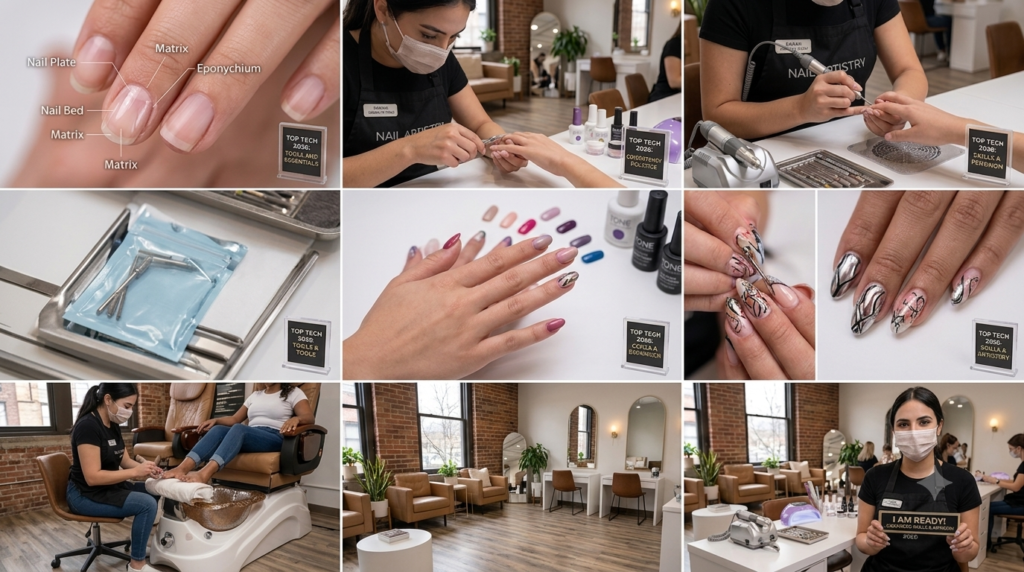
This approach prevents one common beginner mistake: buying a professional-looking kit before developing professional-level skills.
Common Mistakes New Nail Technicians Make
Buying too many products
More products don’t automatically mean better nails.
Copying social-media techniques
A short video rarely explains every safety consideration.
Focusing only on appearance
Healthy nails and safe services should come before an Instagram-perfect finish.
Trying to work too quickly
Speed should come from practice and efficient technique—not rushing.
Ignoring difficult clients
Problem nails are part of real-world work. Learn to assess them appropriately.
Never investing in education
Tools can improve your workflow, but they can’t replace knowledge.
Final Thoughts
Becoming a better nail technician isn’t about finding one magical course, one expensive e-file, or one product that suddenly transforms your work.
It’s about building skills in the right order.
Learn the fundamentals. Understand nail health. Practice your technique. Add specialized skills. Then invest in the tools that support those skills.
If Russian or e-file manicure interests you, specialized training can be a logical next step. If your interests are broader, there are plenty of other areas—nail art, pedicure, structured gel, shaping and professional nail care—that you can explore as your experience grows.
And that’s exactly why it makes sense to think of your education as a long-term skill-building journey, rather than searching for one course that teaches everything.
Your tools will change.
Trends will change.
Products will change.
But strong technique, safety awareness, and professional judgment will always matter.
Frequently Asked Questions
What skills should a nail technician learn first?
Start with nail anatomy, hygiene, basic manicure, nail preparation, shaping, product application, and client safety. Advanced techniques can come later.
Is e-file training worth it?
It can be, especially for technicians who want to offer detailed dry manicure services. However, an e-file should be learned as a professional tool rather than simply purchased and used without instruction.
What is the difference between Russian manicure and a regular manicure?
Russian manicure generally refers to a dry, detailed manicure approach involving an e-file. Traditional manicures may use manual tools and, depending on the service, soaking. Techniques vary between professionals and training providers.
Can I become a nail technician by watching YouTube videos?
Free videos can be useful for learning ideas and practicing certain techniques, but they shouldn’t be considered a complete replacement for professional education, especially for advanced e-file work.
What nail technician tools should a beginner buy?
Start with basic professional-quality tools required for the services you’re trained to provide. Avoid buying large collections of specialized equipment before you know how to use them.
Is online nail technician training good for beginners?
It can be useful, particularly when the course has clear demonstrations and a structured curriculum. Beginners should also get sufficient practical experience and make sure they understand local licensing requirements.
Should I learn Russian manicure or nail art first?
If you’re completely new, build your basic manicure and nail-preparation skills first. After that, choose an advanced area based on the services you want to offer.
Is a nail technician certificate enough to work professionally?
Not necessarily. Education certificates and professional licensing are different. Requirements vary by location, so check the rules applicable to where you intend to work.
Disclosure: This article may contain affiliate links. If you purchase through a link on this page, we may earn a commission at no additional cost to you.